
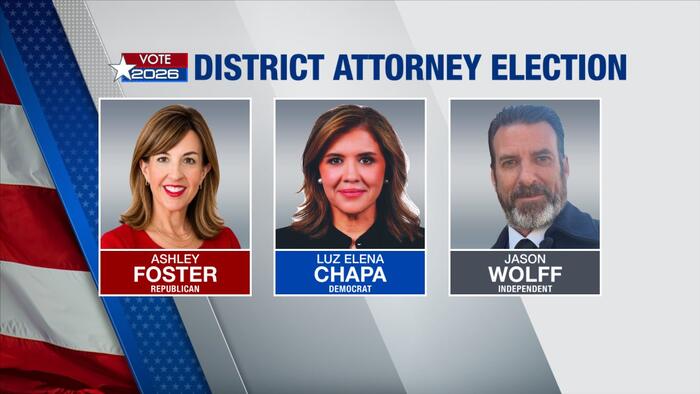
The next Bexar County district attorney will inherit an office facing a backlog of criminal cases, staffing shortages and questions about how prosecutors handle domestic violence allegations.
For the past four years, KSAT has reported on challenges inside the office under District Attorney Joe Gonzales, who is not seeking another term. Now, three candidates are outlining how they would approach the job differently.
Democrat Luz Elena Chapa, Republican Ashley Foster and independent Jason Wolff are competing to lead the office beginning in 2027.
In interviews with KSAT, the candidates discussed how they would address the backlog, handle domestic violence cases, improve morale among prosecutors and make decisions about seeking the death penalty.
While all three say the office needs changes, their approaches differ.
The backlog is among the most pressing challenges facing the next district attorney. The office must also address staffing vacancies and recruit attorneys to handle cases.
Foster said her first step would be to determine the scope of the problem and establish a plan based on the office’s needs.
“We need to go in and find out what is the magnitude of the problem and then begin the hard work of getting on top of it and tackling those issues,” Foster said.
Wolff pointed to the loss of experienced prosecutors as a key concern, saying about 140 prosecutors have left the office over the past several years and now work in surrounding counties.
He said he wants employees to have confidence in the person leading the office, drawing on his own experience trying murder and capital murder cases.
Chapa said she would bring in a strike team to begin addressing the backlog on her first day.
“We are going to tackle that backlog, eliminate it altogether,” Chapa said. She argued that thousands of cases have gone unprosecuted, leaving victims without the justice they were seeking.
Domestic violence prosecutions present another challenge, particularly when victims are afraid to testify or decide they do not want to participate in a case.
The candidates offered different perspectives on how prosecutors should handle those circumstances.
Foster said prosecutors cannot rely solely on victims to testify and should make use of other available evidence, including 911 calls, photographs, police reports and witness statements.
Chapa said she would change how the office evaluates domestic violence cases, focusing on victim protection and evidence-based prosecutions.
Wolff said prosecutors must also account for victims who do not want to move forward with a case. He described situations in which complainants characterize an incident as an isolated dispute and say they want to move on.
The next district attorney will have to determine how the office evaluates evidence, supports victims and makes charging decisions in cases where cooperation is a concern.
The next district attorney will also decide whether prosecutors seek the death penalty in eligible capital murder cases.
Currently, there are multiple high-profile cases where a decision on whether the death penalty would be applied has not been made and will land on the new district attorney.
The candidates differ in how they describe their approach to that decision.
Foster said cases would go through several levels of review, beginning with the prosecutors most familiar with the evidence before moving to a discussion among chief prosecutors. She said she would make the final decision after considering the defendant’s criminal history and potential mitigating factors.
“It’s not going to be just the trial team looking at the case, making the decision,” Foster said. “It’s going to go through several different layers, but will end up on my desk and I will be the one responsible for making that decision.”
Chapa also said she would be the final decision-maker but would rely on a group discussion before deciding whether to seek the death penalty. She said the process should include consideration of the family involved and whether the decision delivers justice.
Wolff was more direct about his position, saying he supports the death penalty. He emphasized that a jury would ultimately decide whether a defendant is guilty of a capital offense and whether the legal requirements for a death sentence are met.
The candidates were also asked whether there are programs or policies under Gonzales that they would preserve.
Chapa praised the office’s restorative justice programs and said she would advocate for more programs with robust funding.
Wolff expressed openness to cite-and-release policies in some cases and pointed to the need to address mental health and substance use issues that can intersect with criminal cases.
Foster said she would not want to overhaul programs without first determining what works.
“Everything that they haven’t gotten wrong would be the things that I would keep,” Foster said. “But the things they’ve gotten wrong that are glaring are the things we’re going to change.”
The next district attorney will be responsible for setting prosecution priorities, managing staffing and resources, and deciding how the office handles cases ranging from domestic violence to capital murder.
For Bexar County voters, the candidates’ plans offer a look at how each would approach an office that has faced years of scrutiny.
The central question is whether the next administration can turn its promises into measurable changes for crime victims, prosecutors, law enforcement and the community.
More election coverage on KSAT:


